The right charger for every voltage.
Industrial battery chargers, pure sine inverters, DC converters, solar and desulfators — 2 to 240 amps, 6 to 156 volts, from the brands that build them to last. No refurb, no guesswork, no sales tax.

Everything between the panel and the battery.
Tell us the pack. We'll size the charger.
Voltage, chemistry, amp-hours and how long you can wait. That is everything needed to pick a charger — and it is the same math our technicians do on the phone.
- Count the cells. 6 cells = 12V, 12 cells = 24V, 24 cells = 48V — then confirm with a meter before ordering.
- Match the chemistry. Flooded, AGM, true gel and lithium each want a different profile.
- Size by amp-hours. Roughly 10% of your Ah rating for a 10-hour recharge; more amps for faster turnaround.
6 cells = 12V · 12 cells = 24V · 24 cells = 48V. Confirm with a meter before ordering.
Hard-to-find voltages we stock: 6V, 8V, 32V, 42V, 96V, 120V, 144V and 156V.
Chargers, inverters, converters & more.
Every unit is fresh stock from the manufacturer at distributor pricing — never used or reconditioned.
Three stages, or you're guessing.
Old trickle chargers hold one amperage forever and cook the battery. A microprocessor charger reads the pack, pushes constant current, then holds absorption voltage until full — and finally drops to float, where it's safe to stay connected indefinitely.
- Bulk — constant current to the absorption set point, as fast as the charger can go.
- Absorption — constant voltage until the pack is genuinely full, not just "looks full".
- Float — maintenance at just enough current to offset self-discharge. No babysitting.
Clean AC. Precise DC.
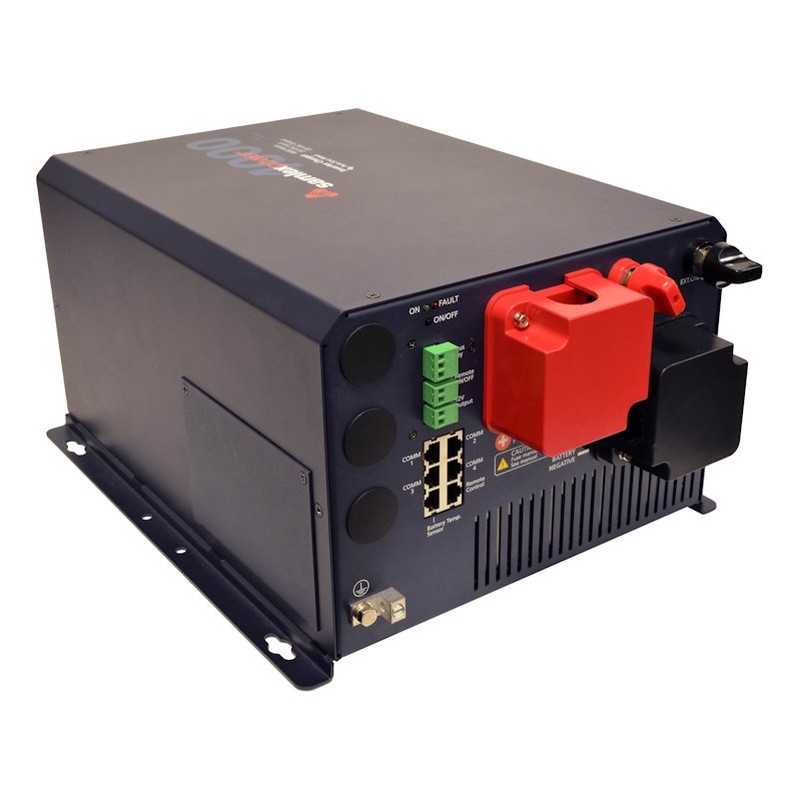
Pure sine inverters give your gear the waveform it was designed for — motors run cooler, clocks keep time, nothing buzzes. DC-DC converters give you a regulated 12V (or 24/48V) rail off a parent pack without imbalance or overcharge.
- Pure sine, 300W – 4,000W across 12, 24 and 48 volt inputs.
- Step-up, step-down, isolated — Samlex IDC/SDC and US-built SEC America units.
- All-in-one EVO combos — inverter, multi-stage charger and transfer switch in one chassis.
Popular chargers, side by side.
| Model | Brand | Output | Type | Warranty | Price | |
|---|---|---|---|---|---|---|
| JAC0512 | Schauer | 12V · 5A | 3-stage smart | 3 yr | $96 | |
| JAC1212 | Schauer | 12V · 12A | 3-stage smart | 3 yr | $108 | |
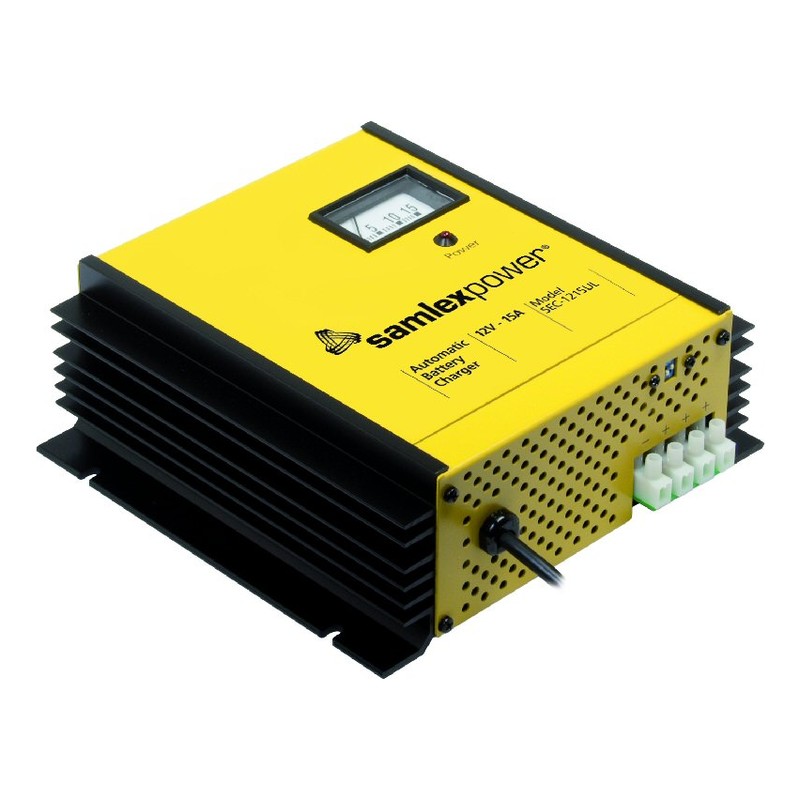
| SEC-1215UL | Samlex | 12V · 15A | Switch mode + PS mode | 2 yr | $210 | |
| JAC2024 | Schauer | 24V · 20A | 3-stage smart | 3 yr | $325 | |
| JAC0348 | Schauer | 48V · 3A | 3-stage smart | 3 yr | $96 | |
| PM3-48-18 | PowerMax | 48V · 18A | Switch mode 3-stage | 1 yr | $251 | |
| QC-QP | Quick Charge | 8V – 72V | Portable, many models | 3 yr | From $289 |
Specs shown are representative — confirm model-specific specs on the product page or call the tech line.
Selected for reliability, design, warranty and value.
The questions we get on the tech line.
What is the difference between a conventional, opportunity and fast charger?
A conventional charger delivers a full charge overnight, usually over 8–12 hours. An opportunity charger adds power in short bursts during breaks and lunch. A fast charger replenishes a large share of capacity quickly, for high-demand shifts — but the battery has to be built to accept that rate, and it costs cycle life.
Can I use any charger on any battery?
No. Voltage must match the pack, and the charge profile must match the chemistry. Gel is the strictest — above roughly 14.4 V on a 12 V system you can bubble the electrolyte permanently. Lithium needs a dedicated LiFePO₄ profile. A selectable charger covers several chemistries; a fixed one only covers the one it was built for.
How many amps should my charger be?
Most manufacturers recommend 10–25% of the battery's amp-hour capacity: a 100 Ah battery wants roughly a 10–25 amp charger. Bigger shortens recharge time but costs battery life; smaller is fine for maintenance. The configurator above does this arithmetic for your pack.
My charger will not recognize the battery — why?
Usually a badly sulphated battery with high internal resistance, a single failed cell, or a loose connection at the clamps. A charger that senses voltage before starting will refuse a battery sitting too low. Charge it on a manual or low-amperage setting first, then retry, and check the pack voltage with a meter.
Do you sell refurbished or reconditioned units?
Never. Every unit is fresh, current-batch stock straight from the manufacturer. That is also why the pricing is lower than most of the web — we buy at distributor level and keep overhead low, not by selling returns.
How fast do orders ship, and how do heavy units arrive?
In-stock orders placed before 1:00 PM PT normally leave the same business day from Rogue River, Oregon. Small chargers ship parcel; larger industrial units ship freight, typically with liftgate and appointment delivery. Call the order line at (877) 405-0978 if you need a specific delivery window.
Still stuck? Call the tech line or read the sizing guides.
Guides that save you a return shipment.
How to size a battery charger
Four numbers decide everything: voltage, amp-hours, chemistry and turnaround time.
Read the guide Charging theoryHow 3-stage charging works
Bulk, absorption and float — plus the target voltages for flooded, AGM and gel.
Read the guide InvertersSizing a pure sine inverter
Surge factors, the watts-to-amps math, and how big the battery bank has to be.
Read the guideTwo generations. One standard.
A 25+ year family business with 30+ years of expertise in electronics and battery repair. We sell the best chargers at the lowest prices — because we're done watching people get taken advantage of.
We're locally owned and operated in Rogue River, Oregon. Our customers keep coming back, and we're looking to expand our family — making sure we provide the best product for the best price, every time. Our lines are American made, because we're American first.
Chat with Larry or Kyle, his son, and figure out how we can solve your battery and charger needs. One of us answers, not a call center.
Kyle
Second generation · orders, fitment & sizing
Tell him the voltage, chemistry and amp-hours — he'll size the charger.
"We're done watching people get taken advantage of."Larry · ChargingChargers.com · Rogue River, Oregon
Talk to a human who owns a meter.
Call the tech line
Tech & order line: (541) 582-4629
Toll free orders: (877) 405-0978
Mon–Fri, 7:30 AM – 4:00 PM PT.
Email a question
Send specs, photos or model numbers to info@chargingchargers.com. We'll reply with the right unit — and the reasoning.
Tutorials & manuals
Charging theory, inverter selection, solar sizing and desulfation explainers — plus every product manual, in plain English.
Not sure what you need? Ask Chargie.
Tell us voltage, battery type, amp-hours and how fast you need to recharge. We'll point you at one model and tell you why.